Creative context disappears
The story, characters, references, and decisions that make a production coherent are scattered across chats and documents.
RadiantWork flagship product
AI can generate a clip. CineVerse helps teams produce a world.
A structured production system that connects story development, directorial shot design, AI generation, takes, review, and asset provenance.
The category shift
AI video tools make striking moments. Professional teams still need a system that can carry intent, continuity, decisions, and accountability across the whole production.
The story, characters, references, and decisions that make a production coherent are scattered across chats and documents.
Prompt formats, workflow graphs, reference limits, and outputs change faster than production teams can standardize around them.
Takes, approvals, continuity notes, and source lineage are reconstructed manually—if they are reconstructed at all.
The missing layer is not another generator. It is the production system around the models.
CineVerse production graph
CineVerse keeps the project spine visible while each production layer becomes more precise.
Explore CineVerse in depthDevelop the premise, character engine, narrative structure, and active story version before production decisions multiply.
Build act-aware outlines and detailed scenes with objective, conflict, turn, visual logic, and continuity context.
Define framing, lens feeling, movement, lighting, references, duration, and a deliberate take strategy.
Resolve stage-aware prompts into validated workflows, preserve the exact execution context, and return outputs to the right shot.
Compare takes, record review decisions, select hero assets, and retain the lineage needed for the next revision.
Designed like studio software
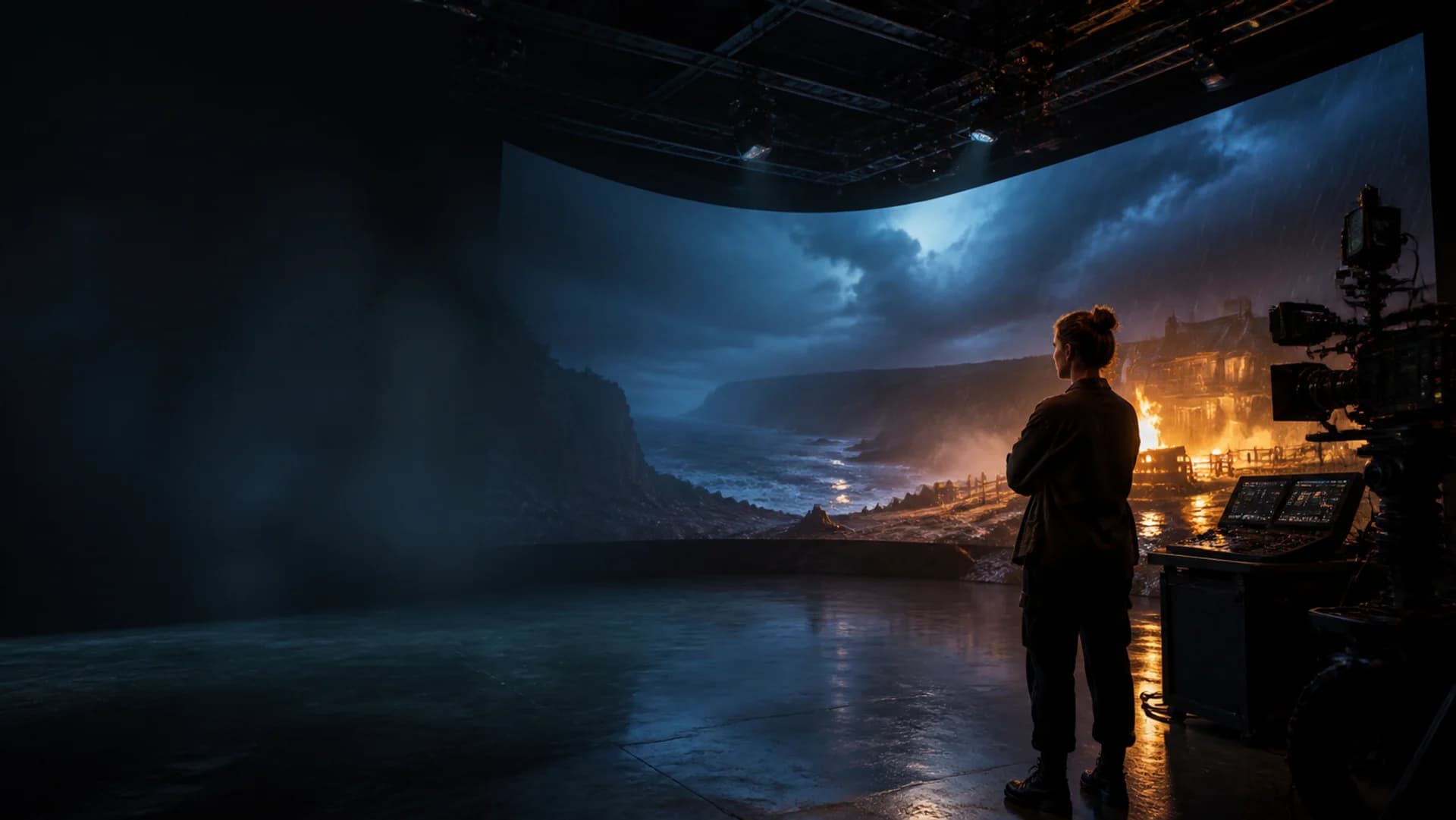
The representative workspace below reflects working CineVerse capabilities; its scene data is illustrative.
The compounding layer
CineVerse is designed to own the structured workflow around the models—not to depend on a single generation model.
Every downstream scene, shot, prompt, job, and asset stays connected to the active project story.
Characters, places, props, references, takes, and human decisions accumulate as reusable structured context.
Stage-aware prompts and workflow contracts let teams evolve the execution layer without rebuilding the creative system of record.
Agents can propose and orchestrate work while approvals, immutable packages, permissions, and audit history preserve human control.
The CineVerse stack
Built beyond a demo
We separate implemented capability from rollout readiness—the same discipline the product brings to generated media.
Versioned ideas, stories, outlines, scenes, and prompts
Directorial shot packages, takes, and retakes
Character and production-continuity management
ComfyUI preflight, submission, job tracking, and asset review
Approval-aware agent orchestration and immutable render context
Automated narrative and prompt quality gates
Production certification across model and workflow revisions
Multimodal continuity comparison and derived-media preparation
Collaboration, finishing, and broader partner integrations
Internal development validation—not customer, revenue, or released-production metrics. Production rendering, rights, and final creative approvals remain gated.
The market entry
Guided pilots can validate revision speed, continuity adherence, and time-to-visual-proof before CineVerse expands deeper into the studio stack.
Move from premise to pitch-ready visual proof with a production structure that can survive revision.
Protect culturally specific worlds, long-form character continuity, and repeatable visual language.
Develop product narratives and controlled campaign variations with reviewable approvals and asset lineage.
Investors · Accelerators · Design partners
See the working product, the architecture, the roadmap, and the guided-pilot thesis.